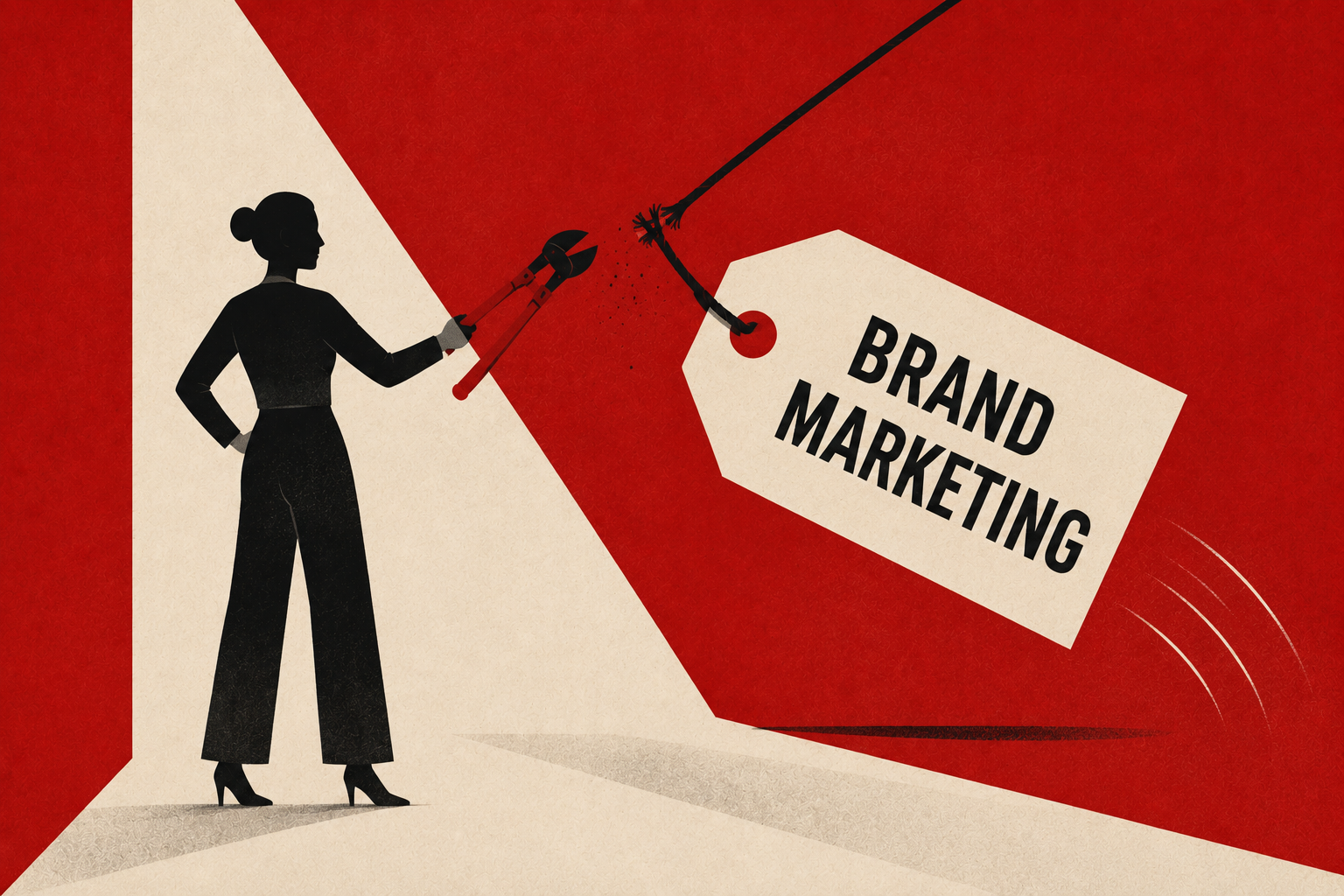
If your growth model still depends on paying for search, you’ll soon be out of luck.
Executives must prepare for the end of the click (H2)
In May 2024, Google CEO Sundar Pichai announced AI Overviews (AIOs), a feature where instead of showing a list of links, Google would answer queries directly using AI.
For brands, that practical little feature has had a tectonic impact on search traffic.
The numbers are staggering. Just after launch, Gartner predicted that by 2026, AIOs will depress traditional search engine volume by 25%. A widely cited Seer Interactive report found year-on-year organic click-through rates (CTRs) – even if a brand appears in results – have recently collapsed by as much as 49% (even 54% for paid).

These figures may reflect the extremes. But independently, several CMOs confirmed to me that their search traffic is down sharply — and maintaining it now costs significantly more than it did two years ago.
Google Is Becoming the Destination (h2)
As ChatGPT, Perplexity and the like are eating into search, Google is doing everything it can to keep users inside its own interface.
With AI Overviews, the platform is moving from a traffic distributor to an active intermediary that captures attention, shapes decisions, and monetises both. Brands are no longer just competing with other brands. They are competing with the interface itself.
For two decades, marketers treated Google like a demand vending machine: insert budget, select keywords, receive customers. We built an entire profession around tweaking websites and keywords, so that brands show on Google page one.
Search marketing worked because of an implicit agreement: Google passes people on.
That agreement has now been cancelled – and it’s just a preview of what comes next.
Increasingly, AI agents can make purchasing decisions on behalf of humans. The platforms will no longer just be intermediaries. They could turn into buyers.
Marketers are again flocking to optimise for this. Generative Engine Optimisation (GEO) trainings are full. Sure, GEO is a no-regret move. But growth from such optimising still rests on one assumption, that in the future, platforms will still send customers your way.
They might do, but equally, they might not.
Brands and Relationships (h3)
As optimising auctions becomes harder, strong brands and direct customer relationships will decide the winners.
People search “Porsche”, not “fast car”. “Swiffer”, not “disposable duster”. “PlayStation”, not “computer game”. If customers look for your brand instead of the category, you have already won half the battle.
Where does the AI learn what the customer prefers? From the human’s past behaviour. If your brand is already preferred, the machine learns that preference and acts on it. If your brand is unknown, the machine sorts by price and availability. You become a commodity by default.
For years, marketers have shifted budgets away from brand building into so called “performance marketing”. It was easier to do that traditional campaigning, as it was quick and promised easy returns. Many of us have pointed out that imbalance. Now the bill arrives.
Strong brands survive platform shifts; weak brands probably won’t. In a world where you can’t reliably pay platforms to send customers your way, a strong brand will remain the best insurance policy.
A good image and salience aren’t enough. Strong brands build preference — the third step in the funnel after awareness and consideration. Preference is what makes someone ask for you by name, before they even check out alternatives. You can’t buy that. You can’t GEO-optimise your way to it. Building preference requires the full 4Ps marketing toolkit — as well as insight, creativity, and consistency.
There’s another path to thrive outside the platforms and that’s direct customer relationships. Not attribution models, not dashboards — actual connections. Be that email lists, loyalty programs, apps, user groups, subscriptions. Every direct relationship you own has compounding value.
From L’Oréal to Air France to Adobe, brands worldwide have made the shift to direct relationships. It won’t work for all categories. B2B or service brands will, admittedly, find this easier.
And building customer relationships is much more work than paying a platform to send people to you. You have to earn the opt-in. But the return is a feedback loop and an audience no platform can take away.
A refocus on brands and relationships doesn’t mean abandoning Google. To the contrary. To build brand preference and relationships, marketers must deploy the most effective channels — online and offline — including social, AI agents, YouTube, TV, and more.
For strong brands, the switch will be easier. For weaker ones, it means surviving the search drop while building brand strength and relationships simultaneously. That’s harder. But it’s the only switch worth making.
The click is fading. Strong brands and customer connections scale. They always have.